
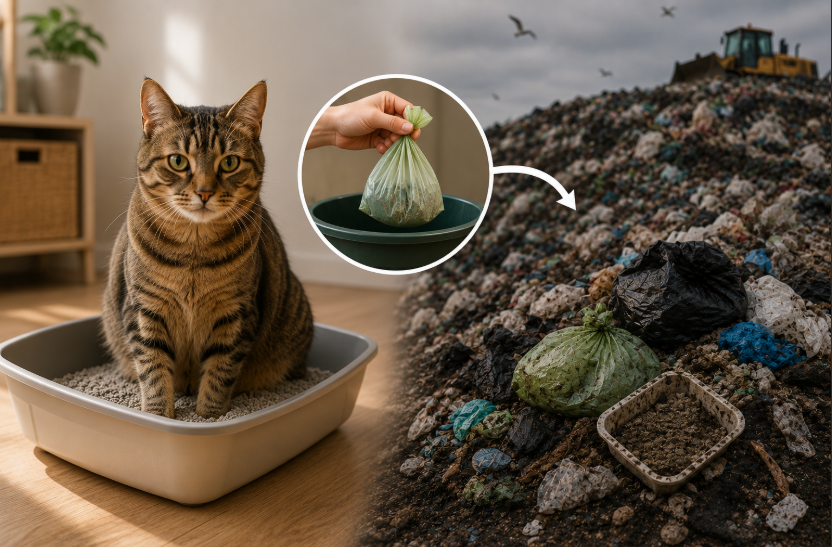
Your Pet's Daily Routine Is Quietly Filling Up Landfills — Here's What to Do About It
You're a responsible pet owner. You pick up after them every single time. But the products you rely on every day may have a bigger footprint than you think — and the fixes are easier than you'd expect.
You love your pet. You buy them the good food. You take them to the vet. You pick up after them — every single time — because you're that responsible owner. But here's something nobody really talks about: the very act of caring for your pet leaves a surprisingly large trail of plastic and non-biodegradable waste behind you.
Not because you're doing anything wrong. Just because most of the products we reach for — poop bags, urine pads, kitty litter, pet diapers — were designed for convenience, not the planet. This isn't about guilt. It's about awareness. Once you see it, there are some genuinely easy swaps that make a real difference. And because your pet's overall health and nutrition play a role in their waste output too, understanding what goes into their food matters just as much as how you handle what comes out. You can explore how diet affects your cat's digestive health in our guide to cat digestive health and nutrition.
The Quiet Math of Pet Waste Products
If your dog goes outside three times a day, you're using over 1,000 poop bags a year from your household alone. A peer-reviewed study published in Environmental Pollution (2021) estimated that approximately 415 billion plastic poop bags are disposed of globally every year — equivalent to 0.76 to 1.23 million tons of plastic waste. The same research highlighted that even bags marketed as "biodegradable" rarely degrade under real landfill conditions due to anaerobic, oxygen-deprived environments.
Cat litter is its own story. According to data cited by Earth911 and the Pet Sustainability Coalition, Americans send an estimated two million tons of used clay cat litter to landfills every year — strip-mined from the earth, used once, then buried where it will sit essentially unchanged for centuries. Clay litter is not biodegradable. It doesn't break down. It just accumulates. The American Pet Products Association (APPA) 2023–2024 National Pet Owners Survey reports that there are approximately 66.3 million cat-owning households in the U.S., underscoring the massive collective scale of this waste stream.
Add urine pads, pet diapers, and packaging, and your pet has a surprisingly sizeable footprint. None of this means you should feel bad. It means there's a real opportunity to make changes that matter. For a deeper look at how your cat's diet directly influences their waste volume and consistency — and what that means for litter box management — see our guide to choosing the best cat food.
Product by Product: What's Actually Happening
Standard poop bags are made from low-density polyethylene (LDPE) — the same material as grocery bags. In a landfill, even bags marketed as "biodegradable" largely don't break down. As the U.S. Environmental Protection Agency (EPA) notes, landfills are sealed, oxygen-deprived environments that are specifically designed to slow decomposition. Compostable bags require oxygen, moisture, and microbial activity — conditions a sealed landfill almost never provides.
The ASTM D5511 standard (published by ASTM International) specifically tests degradation under anaerobic (no-oxygen) conditions — the type that most closely replicates real-world landfill and home composting environments. This is the certification to look for on poop bags. The Biodegradable Products Institute (BPI) also provides independent third-party certification for compostable products sold in North America.
What helps:
- Certified compostable bags (ASTM D5511) used with a home or pet-waste composter
- Reusing bread bags, produce bags, or newspaper sleeves already heading for the bin
- Paper-based pick-up sheets like Pooch Paper — PFAS-free and compostable per manufacturer specifications
Skip these:
- "Oxo-biodegradable" bags — the European Commission has flagged these as fragmenting into microplastics rather than organic matter
- Bags labeled "biodegradable" with no third-party certification — this term has no regulatory definition in the U.S. under FTC Green Guides
Most U.S. cat litter is sodium bentonite clay — a mineral that clumps effectively when wet but never breaks down in a landfill. According to reporting by the Washington Post and industry data cited by Earth911, approximately 8 billion pounds of clay is mined annually in the U.S. for use in kitty litter. Strip mining for bentonite removes topsoil, disrupts ecosystems, and permanently alters land.
Plant-based litters — made from corn, wheat, pine, or walnut shell — are genuinely biodegradable. Some are certified flushable, though the ASPCA advises caution about flushing cat waste, as Toxoplasma gondii (a parasite shed in cat feces) is not always eliminated by municipal water treatment. If budget is a concern, a 50/50 clay and plant-based blend halves your clay use while keeping costs manageable.
Transition cats slowly over one to two weeks — sudden changes often cause litter box avoidance. The American Association of Feline Practitioners (AAFP) recommends gradual litter transitions to minimize stress-related house soiling. For guidance on how your cat's diet affects their litter box habits and stool consistency, see our article on understanding your cat's litter box behavior.
Lower-waste alternatives:
- Plant-based litters — corn, wheat, pine, or walnut shell (biodegradable, renewable resources)
- Recycled paper litter — biodegradable, low dust, often recommended for post-surgical cats by veterinarians (VCA Animal Hospitals)
- Wood pellet litter — often the most affordable eco option; highly absorbent
- 50/50 clay + plant-based blend — a budget-friendly middle ground during transition
Disposable pee pads and pet diapers share the same basic construction as single-use baby diapers — polyethylene outer layers, super-absorbent polymer (SAP) gel cores, and polypropylene inner liners. According to research on infant diaper waste (directly comparable in material composition), these products can take hundreds of years to break down in landfill conditions. One to two pads a day means up to 730 per year per household. For pets requiring multiple diaper changes daily — due to incontinence, post-surgical recovery, or hormonal issues — the volume adds up rapidly.
For pets with urinary issues or incontinence, the VCA Animal Hospitals recommend first addressing the underlying medical cause with a veterinarian before relying solely on management products. Washable reusable pads have improved significantly — modern multi-layer versions with waterproof TPU backing are rated for 200–300 machine wash cycles per manufacturer specifications, making the long-term economics strongly favorable over disposables.
Lower-waste options:
- Washable reusable pee pads — rated for 200–300 washes, lower long-term cost
- Washable cloth pet diapers with removable inserts
- Belly bands for male dogs with marking behavior — widely recommended by trainers and veterinarians as a management tool
- Hybrid approach: reusable pads in low-traffic areas, disposables only where most needed
Frequent urination, loose stools, and strong-smelling waste are often diet-related. Learn how to evaluate your cat's food for quality and digestibility:
How to Read a Cat Food Label
Wet vs. Dry Cat Food: What the Research Says
Cat Hydration and Urinary Health
The Swap Table at a Glance
| Product | Standard version | Lower-waste swap | Key guidance source |
|---|---|---|---|
| Dog poop bags | LDPE plastic bags | ASTM D5511 certified compostable + home composter, or reuse bread/produce bags | ASTM International; BPI |
| Cat litter | Bentonite clay (strip-mined, non-biodegradable) | Corn, pine, walnut, or recycled paper litter; transition cats slowly over 1–2 weeks | AAFP; VCA Animal Hospitals |
| Urine pads | Disposable plastic-backed pads (~500 yr landfill lifespan) | Washable reusable pads (200–300 washes); higher upfront cost, lower long-term cost | VCA Animal Hospitals |
| Pet diapers | Disposable plastic/SAP diapers | Washable cloth diapers with removable inserts; belly bands for male dogs | ASPCA |
| Pet food packaging | Multi-layer flexible plastic pouches (largely unrecyclable) | Larger bag formats; brands participating in Pet Sustainability Coalition packaging programs | Pet Sustainability Coalition |
Don't Get Greenwashed
The pet product industry has the same labeling problem as every other consumer category. The FTC Green Guides provide some consumer protection in the U.S., but enforcement in the pet space is limited. Here's a quick decoder for the terms you'll encounter most often:
| ⚠️ Be skeptical of these terms | |
| "Biodegradable" | No standard U.S. regulatory definition. The FTC requires that claims be qualified (specifying conditions and timeframe), but enforcement in pet products is limited. Meaningless without a third-party certification. |
| "Eco-friendly" | Pure marketing language with no regulatory definition in the U.S. or EU. The EU Green Claims Directive is moving to ban unsubstantiated claims like this in Europe. Ignore unless backed by a verifiable third-party certification. |
| "Oxo-biodegradable" | Fragments into microplastics rather than organic matter. The European Commission has formally restricted these materials, noting they may be worse than conventional plastic. The BPI explicitly excludes oxo-degradable materials from its certification program. |
| "Compostable" (no cert) | Only meaningful if you're actively composting the product under the right conditions. In a sealed landfill it behaves essentially like regular plastic. The EPA notes that composting requires specific temperature, moisture, and microbial conditions absent from sealed landfills. |
| ✓ Certifications to actually trust | |
| ASTM D5511 | Published by ASTM International. Tests degradation under high-solids anaerobic (no-oxygen) conditions — most closely replicates real-world home composting and landfill-adjacent environments. This is the standard most relevant for poop bags and pet waste products. |
| ASTM D6400 | ASTM International standard for industrial/commercial composting facilities. Requires degradation within 180 days at elevated temperature. Only applicable if a commercial composting facility is accessible and accepts the material. |
| BPI Certified Compostable | Third-party certification from the Biodegradable Products Institute. Products must pass ASTM D6400 or D6868 testing. The BPI logo is one of the most reliable indicators of genuine compostability in North America. |
| FSC Certified | Forest Stewardship Council certification ensures wood and paper products come from responsibly managed forests. Look for this on paper-based litters, cardboard packaging, and wood-pellet litter products. |
How to Start: The Replace One Thing Approach
Pick one product — the one you use most often or feel most bothered by — and make one swap. See how it goes. If it works, pick another. For most households, the highest-impact swap is cat litter because of the sheer volume and the upstream environmental cost of strip mining. Second is poop bags, because of daily volume and the lack of any meaningful end-of-life solution for standard LDPE plastic under real landfill conditions (per EPA plastics data).
It's also worth noting that diet quality affects waste volume directly. Cats and dogs on highly digestible, species-appropriate diets tend to produce less waste overall. The American Veterinary Medical Association (AVMA) recommends working with your veterinarian to assess whether your pet's current diet meets their nutritional needs, which in turn supports healthy, predictable digestion. See our complete cat food guide for vet-informed recommendations by life stage.
- Identify your highest-volume product — usually litter (for cat owners) or poop bags (for dog owners)
- Pick one lower-waste alternative from the swap table above, prioritizing products with third-party certification (ASTM D5511, BPI, FSC)
- Try it for 2–4 weeks — give it a real chance before judging (especially with litter transitions for cats, per AAFP guidelines)
- If it works: keep it and pick the next product to swap
- If it doesn't: try a different alternative in the same category rather than reverting — most categories have several viable options


