
If your cat has stopped jumping onto the bed or takes the stairs one careful step at a time, you may be wondering whether a diet for cats with arthritis could help. Nutrition won’t replace veterinary care, but it can be one part of a plan your vet puts together alongside pain relief and home changes. This guide explains what the evidence says about weight, omega-3 fatty acids and joint supplements, and how to talk about them with your vet.
By Cat Nutrition Guide Editorial. This article is general information, not veterinary advice.
Arthritis in Cats Is Common and Easy to Miss
VCA Animal Hospitals describes osteoarthritis as common in cats, and notes it becomes more likely as cats age. International Cat Care notes it often goes undiagnosed because cats quietly cut back on activity to avoid discomfort.
Signs worth mentioning to your vet
Based on International Cat Care and the University of Guelph’s pet nutrition team, watch for:
- Hesitating before jumping up or down, or not jumping at all
- Stiffness after resting, or trouble with stairs
- Less grooming, or a matted coat over the back and hips
- Sleeping more and playing less
- Irritability when picked up or touched
- Toileting outside the litter box
Only a vet can confirm arthritis and rule out other causes. Your vet may recommend pain relief as part of treatment, and diet works best as one piece of that plan.
Step One: Get to a Healthy Weight
For many cats, the most useful dietary change isn’t a special ingredient. It’s weight. International Cat Care notes that excess weight places extra strain on sore joints. VCA adds that body fat releases inflammatory substances that may make joint pain worse.
That means a lean body condition is worth aiming for. VCA describes a healthy shape as a visible waist from above, a tucked belly from the side, and ribs you can feel easily but not see.
How weight loss usually works
- Ask your vet for a target weight and calorie goal. Your vet can also advise on a safe rate of loss.
- Measure every meal. A kitchen scale is more accurate than a scoop.
- Consider a veterinary weight-loss diet. VCA notes that therapeutic weight-loss diets are typically higher in protein and fiber and lower in fat.
- Count treats. Small extras add up quickly in a small animal.
Our cat weight loss diet guide covers the process in more detail.
Omega-3 Fatty Acids and Joint Comfort
Among joint-related nutrients, omega-3 fatty acids have some of the better evidence. VCA explains that a diet rich in the omega-3s EPA and DHA can help modify chronic joint inflammation. The University of Guelph’s pet nutrition team also rates the research on omega-3s more favorably than the research on other joint supplements.
Dose and source matter
A food that simply mentions “omega-3” on the bag may not contain enough to make a difference. VCA warns that many over-the-counter products don’t reach effective levels, and that veterinary joint or weight diets often include targeted amounts of EPA and DHA.
Keep these points in mind:
- Ask your vet which source and product they prefer, since products vary widely.
- Ask your vet for a dose based on your cat’s weight, especially if your cat takes other medications.
- Ask how to introduce any new supplement, and what side effects to watch for.
For more background, see our guide to omega-3 for cats.
What About Glucosamine and Chondroitin?
These are some of the best-known joint supplements, but the evidence in cats is weak. VCA states that controlled studies have failed to show a beneficial effect in cats or dogs. The University of Guelph summary rated glucosamine and chondroitin as the lowest-evidence category it reviewed.
Some vets may still suggest trying them for an individual cat, and International Cat Care lists them among supplements to discuss with your vet. The practical takeaway: don’t rely on them in place of pain relief or weight control, and ask your vet before buying.
Choosing a supplement carefully
Quality varies between products. VCA suggests choosing products that have been independently tested for purity and strength. Tell your vet about every supplement your cat takes.
When Arthritis Isn’t the Only Condition
A cat with arthritis may have other health conditions too, and each may come with its own dietary needs. VCA notes that vets may need to prioritize, and that a board-certified veterinary nutritionist can help balance competing needs. Never switch a cat off a prescribed diet without your vet’s input.
Putting Together a Diet for Cats With Arthritis
It helps to think of a diet for cats with arthritis as a plan you build with your vet, rather than a single product you buy. A typical sequence looks like this:
- Start with an exam. Your vet confirms the diagnosis, checks body condition and looks for other conditions that affect food choices.
- Set a weight goal. If your cat is overweight, agree on a target weight and a daily calorie budget.
- Choose the base food. This might be your cat’s current complete and balanced food in measured portions, or a veterinary weight or joint diet.
- Decide on omega-3s. If the base food doesn’t already supply an effective amount, ask whether a supplement makes sense and at what dose.
- Adjust the home setup. Make food, water and litter easy to reach without jumping.
- Recheck and adjust. Weigh your cat at home on a regular schedule, note mobility changes, and book follow-ups as your vet suggests.
Keep a short diary of weight, appetite and how your cat moves. Small improvements, like jumping onto a low chair again, are easy to forget without notes.
Wet or dry food?
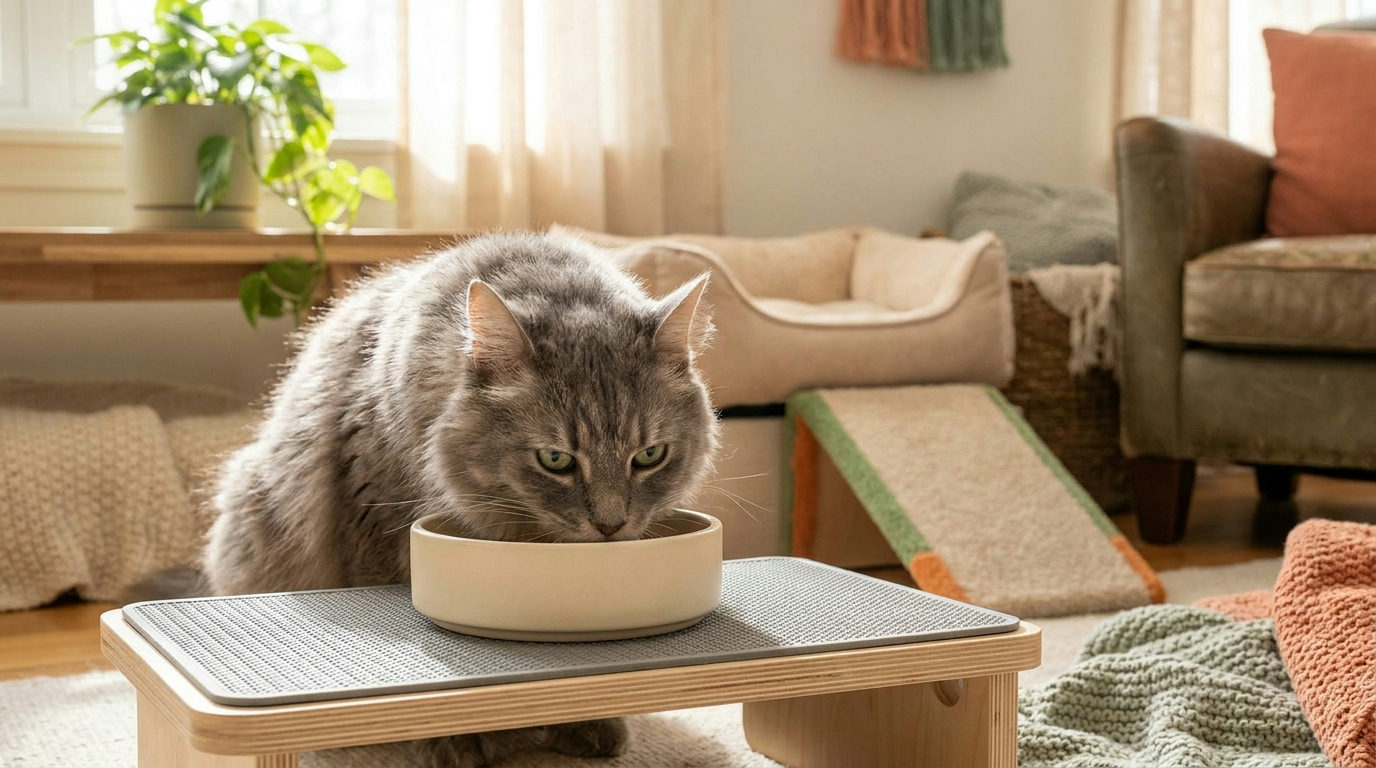
There’s no single best format for arthritic cats. What usually matters more is the total daily calories, the nutrient profile, and whether the food suits any other health conditions. If your cat finds it hard to crouch over a bowl, try a wide, shallow dish on a low, stable platform. Whichever you choose, measure portions and stay within the calorie budget your vet sets.
Make Mealtimes Easier on Sore Joints
How you feed can matter as much as what you feed. International Cat Care recommends placing food and water where your cat doesn’t have to jump, or adding steps to favorite high spots. Other helpful changes include:
- Bowls on the floor or on a low, stable platform
- Non-slip mats around feeding areas on smooth floors
- Low-sided litter boxes, kept indoors
- Soft beds in warm, draft-free spots near food and water
- Ramps or steps to windowsills and sofas
Gentle play, such as rolling a toy along the floor, keeps your cat moving without hard landings. If you use food puzzles, pick easy ones placed at floor level.
Questions to Ask Your Vet
- Is my cat at a healthy weight for its joints? If not, what’s the target?
- Would a veterinary joint or weight-loss diet suit my cat?
- Should I add an omega-3 supplement, and at what dose?
- Is it worth trying any other supplement, given the evidence?
- Do my cat’s other conditions affect which diet is best?
- What pain relief options are safe for my cat?
The Bottom Line
A good diet for cats with arthritis starts with a lean, healthy weight, which may ease strain on sore joints. Omega-3 fatty acids (EPA and DHA) may help support joint comfort when your vet advises an effective dose. Glucosamine and chondroitin have limited evidence in cats. Above all, nutrition works best as part of a vet-guided plan that includes pain management and a home set up for easy movement.
This article is general information, not veterinary advice. Talk to your veterinarian before changing your cat’s diet or adding supplements.


