
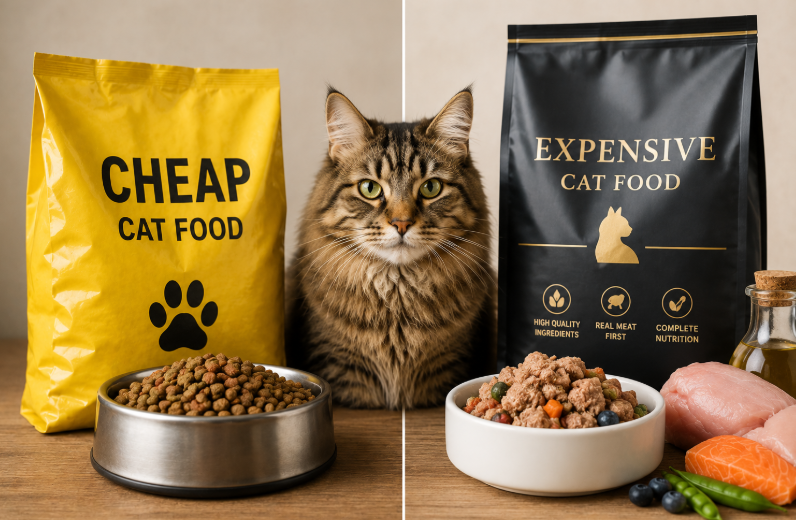
Walking through a pet store can be overwhelming. Some cat foods cost only a few dollars, while others come with premium price tags that seem difficult to justify. This often leads owners to wonder whether expensive products are truly better or if budget-friendly options can provide similar benefits. Understanding cheap vs expensive cat food helps separate marketing claims from nutritional facts and allows owners to make informed decisions that support both feline health and household budgets.
Price differences in cat food exist for many reasons. Ingredients, manufacturing methods, research investments, branding, packaging, and distribution costs all contribute to the final price consumers see on store shelves. However, higher cost does not automatically guarantee superior nutrition. Likewise, a lower-priced product is not necessarily poor quality.
The key is learning what you are actually paying for. Some premium foods offer meaningful nutritional advantages, while others simply charge more because of marketing and branding. By understanding how cat food is formulated and sold, owners can focus on value rather than price alone.
A healthy feeding plan depends on selecting food that meets a cat’s nutritional needs. The smartest choice is often the one that balances quality, affordability, and long-term health benefits.
Why Cat Food Prices Vary So Much
The discussion around cheap vs expensive cat food often begins with understanding why prices differ so dramatically. Several factors influence manufacturing costs before a product ever reaches a store shelf.
Ingredient selection is one of the biggest factors. Foods that use high-quality animal proteins such as chicken, turkey, salmon, or lamb generally cost more to produce than formulas relying heavily on lower-cost ingredients. Protein sources are often among the most expensive components of pet food production.
Manufacturing standards also contribute to pricing. Companies that invest in advanced quality control systems, extensive testing, and strict safety procedures may have higher production costs. These expenses often become part of the product’s retail price.
Research and development represent another consideration. Some manufacturers employ veterinary nutritionists and conduct feeding trials to evaluate product performance. Scientific research requires substantial investment, which may increase costs.
Marketing also plays a major role. Premium packaging, advertising campaigns, celebrity endorsements, and brand positioning often influence pricing even when nutritional differences are modest.
Understanding these factors helps explain why products can vary so widely in cost despite appearing similar at first glance.
The Role of Ingredients in Food Quality
When evaluating cheap vs expensive cat food, ingredient quality deserves close attention. However, it is important to remember that ingredient lists tell only part of the story.
High-quality cat foods often feature clearly identified animal proteins as primary ingredients. Chicken, turkey, salmon, and beef provide valuable amino acids that support muscle maintenance and overall health. Because cats are obligate carnivores, animal-based proteins play an essential role in their diets.
Budget-friendly foods sometimes contain more plant-based ingredients or less expensive protein sources. While these products can still meet nutritional requirements, the quality and digestibility of ingredients may vary.
Ingredient transparency also matters. Named ingredients provide more information than vague descriptions such as animal by-products or meat derivatives. Consequently, many owners prefer foods that clearly identify protein sources.
At the same time, expensive ingredients alone do not guarantee nutritional superiority. A well-balanced formula with moderate-cost ingredients may provide excellent nutrition if it is properly formulated.
Therefore, evaluating ingredients requires looking beyond individual components and considering the overall nutritional profile of the food.
Understanding Nutritional Balance
The most important factor in the cheap vs expensive cat food debate is nutritional adequacy. Regardless of price, cat food should provide complete and balanced nutrition appropriate for the cat’s life stage.
Cats require specific nutrients, including protein, fat, vitamins, minerals, and taurine. Deficiencies can lead to serious health issues over time. Therefore, ensuring nutritional completeness is more important than focusing exclusively on premium ingredients.
A properly formulated budget food may provide better nutrition than an expensive product with unbalanced nutrient levels. Consequently, owners should prioritize nutritional standards rather than assuming higher prices always indicate better quality.
Products that meet recognized nutritional guidelines provide reassurance that essential nutrient requirements are being addressed. These standards help ensure cats receive appropriate support for growth, maintenance, reproduction, or aging.
Balanced nutrition supports healthy muscles, strong bones, immune function, and overall well-being. Therefore, evaluating nutrient content often provides more meaningful insight than comparing prices alone.
The best food is one that consistently delivers the nutrients a cat needs while fitting comfortably within the owner’s budget.
How Marketing Influences Perception
Marketing has a significant impact on how consumers view cheap vs expensive cat food. Many products use attractive packaging and persuasive language to create impressions of superior quality.
Words such as premium, holistic, gourmet, natural, and artisanal often appear on packaging. While these terms sound appealing, they do not always indicate meaningful nutritional advantages. In many cases, marketing language influences purchasing decisions more than actual ingredient quality.
Premium brands frequently invest heavily in advertising campaigns. These efforts can increase product visibility and create perceptions of exclusivity. However, marketing expenses are often reflected in the final price.
Some products highlight trendy ingredients or popular dietary philosophies. Grain-free formulas, exotic proteins, and specialized ingredient lists may attract attention even when their nutritional benefits are not universally necessary.
This does not mean premium products lack value. Rather, it means consumers should evaluate nutritional facts alongside marketing messages. Understanding the difference between branding and nutrition helps prevent unnecessary spending while supporting better decision-making.
Informed owners focus on evidence rather than promotional claims when selecting food.
Manufacturing Standards and Safety
One area where higher-priced products may offer advantages is manufacturing quality. Discussions about cheap vs expensive cat food often overlook the importance of production standards.
Reputable manufacturers typically invest in ingredient testing, quality assurance programs, and facility oversight. These measures help ensure product consistency and reduce contamination risks.
Some companies perform extensive testing on both ingredients and finished products. They may also conduct feeding trials to evaluate nutritional performance under real-world conditions. These practices increase costs but can contribute to product reliability.
However, higher prices do not automatically guarantee superior safety. Many affordable brands maintain strong quality control programs and meet rigorous industry standards. Therefore, researching company reputation often provides more useful information than focusing solely on price.
Transparency is another valuable indicator. Manufacturers willing to discuss sourcing practices, quality controls, and nutritional philosophy often inspire greater confidence.
Safety and consistency remain important regardless of budget. Choosing products from reputable companies helps reduce uncertainty and supports long-term health.
When Expensive Food May Be Worth the Cost
There are situations where spending more money makes sense. The cheap vs expensive cat food comparison becomes more nuanced when individual health needs are considered.
Cats with food sensitivities, allergies, digestive disorders, or chronic medical conditions may benefit from specialized diets. These formulas often require unique ingredients, targeted nutrient profiles, and additional research investments.
Veterinary therapeutic diets are another example. While these products often cost more than standard foods, they are designed to support specific medical conditions and may improve quality of life significantly.
Some premium foods also emphasize ingredient sourcing, digestibility, and nutritional precision. For certain cats, these factors may provide noticeable benefits.
Additionally, highly digestible foods can sometimes result in better nutrient absorption. Consequently, owners may feed smaller portions while maintaining nutritional adequacy.
The value of expensive food depends on whether it delivers meaningful benefits for the individual cat. In some cases, the additional cost is justified. In others, a more affordable product may perform equally well.
When Affordable Food Can Be a Smart Choice
Many owners assume that lower-priced products are automatically inferior. However, the reality of cheap vs expensive cat food is often more balanced.
Numerous affordable foods provide complete and balanced nutrition while supporting excellent health outcomes. These products may lack premium branding or trendy ingredients, yet still meet established nutritional standards.
Budget-friendly foods can be especially valuable for households managing multiple cats. Feeding several pets becomes more affordable when owners focus on nutritional value rather than premium marketing.
Consistency also matters. A moderately priced food that owners can purchase reliably may be preferable to an expensive option that creates financial strain. Sudden food changes caused by budget concerns can sometimes be more disruptive than selecting a quality affordable product from the beginning.
Many cats thrive on reasonably priced diets when those foods meet nutritional requirements and are fed appropriately. Therefore, affordability should not automatically be viewed as a disadvantage.
The goal is finding the best combination of quality, nutrition, and sustainability for both the cat and the owner.
How to Evaluate Value Instead of Price
A better approach than focusing solely on cheap vs expensive cat food is evaluating overall value. Value considers what a product delivers relative to its cost.
Start by examining nutritional adequacy. Ensure the food provides complete and balanced nutrition for your cat’s life stage. Then review ingredient transparency and protein sources.
Research the manufacturer as well. Companies with strong reputations, transparent practices, and consistent quality control often provide greater confidence.
Consider your cat’s response to the food. Healthy weight maintenance, normal digestion, good energy levels, and a healthy coat often indicate that nutritional needs are being met effectively.
Cost per serving can also provide useful insight. Some premium foods require smaller portions because of higher calorie density or digestibility. As a result, actual feeding costs may differ from sticker prices.
By evaluating value comprehensively, owners can avoid overpaying for marketing while still supporting excellent nutrition.
Conclusion
The debate surrounding cheap vs expensive cat food is more complex than many people realize. Price alone does not determine quality, and expensive products are not automatically superior. Likewise, affordable foods are not necessarily poor choices. Ingredient quality, nutritional balance, manufacturing standards, scientific research, and individual feline needs all contribute to a food’s overall value.
The smartest approach is to focus on nutrition, transparency, and long-term health outcomes rather than price tags alone. By understanding what influences food costs and evaluating products objectively, owners can make confident decisions that support their cats without overspending. Ultimately, the best cat food is one that provides complete nutrition, fits your budget, and helps your feline companion enjoy a healthy and active life.
FAQ
1. Is expensive food always healthier for cats?
No. Higher prices do not automatically indicate better nutrition. Nutritional balance and ingredient quality matter more.
2. Can budget-friendly foods meet nutritional needs?
Yes. Many affordable foods provide complete and balanced nutrition when formulated properly.
3. Why do some cat foods cost significantly more?
Higher costs may reflect ingredient sourcing, research, manufacturing standards, marketing, or specialized formulations.
4. Are premium ingredients always necessary?
Not always. Many cats thrive on moderately priced foods that provide balanced nutrition and quality protein sources.
5. What should I focus on when choosing a cat food?
Prioritize nutritional adequacy, ingredient transparency, manufacturer reputation, and how well the food supports your cat’s health.


