
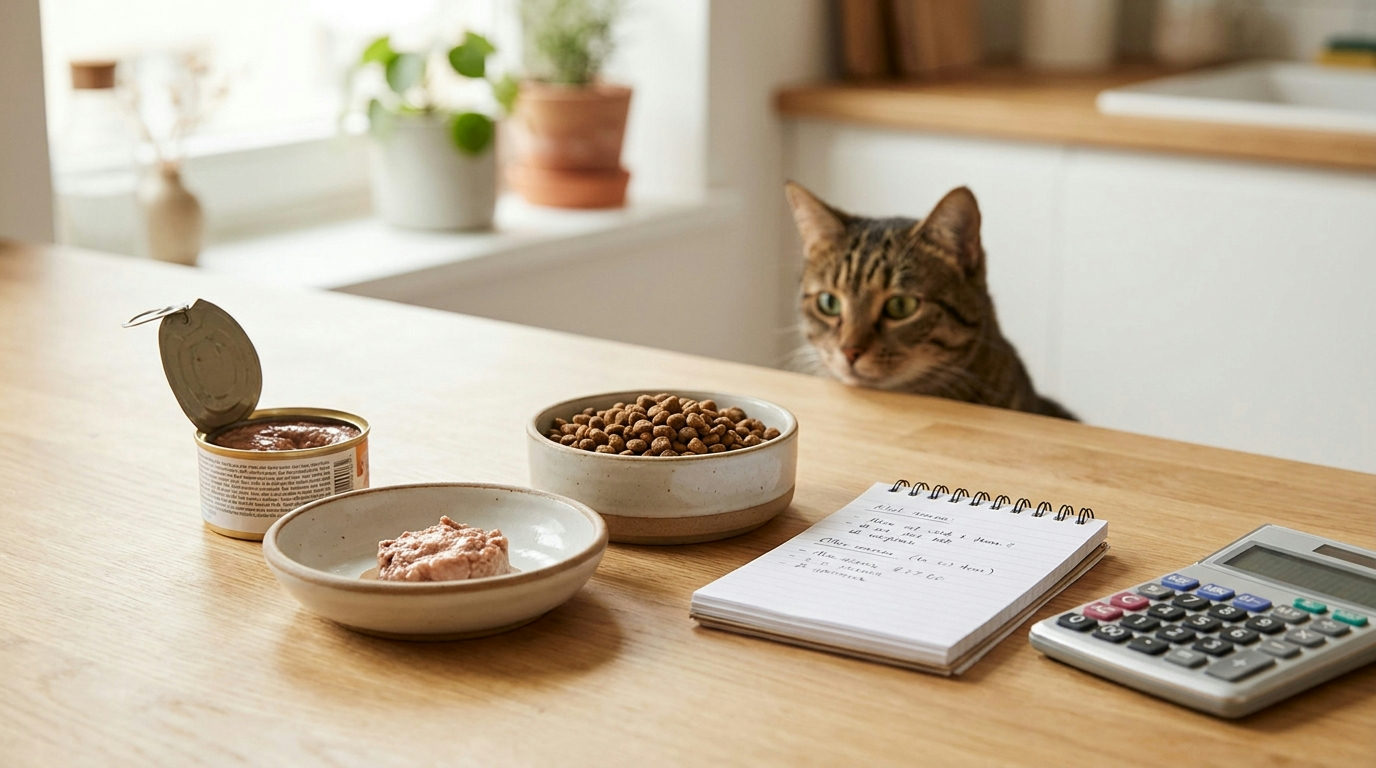
You pick up a can of wet food and see 10% protein. Then you look at a bag of kibble and see 32% protein. It looks like the kibble wins by a mile. In fact, the two foods may be very close. The difference is water, and the way to see past it is the cat food dry matter basis. This guide walks through the math step by step, with a worked example you can reuse at the shelf.
Disclosure: Cat Nutrition Guide may earn a commission from qualifying purchases made through links on this page, at no extra cost to you.
Why Label Percentages Can Mislead You
Every cat food label in the US carries a guaranteed analysis. It lists minimum crude protein and fat, plus maximum fiber and moisture. However, those numbers are given “as fed.” That means they include all the water in the food.
Wet food is often around 75 to 82% water. Dry food is often around 8 to 12% water. So the nutrients in a can are diluted by far more water than the nutrients in a bag. As a result, comparing the raw label numbers is a bit like comparing the sugar in a glass of juice with the sugar in a handful of raisins.
The AAFCO consumer guide to pet food explains what the guaranteed analysis does and does not tell you. In short, it gives you limits, not exact amounts, and it reports them with the water included.
What Dry Matter Basis Means
Dry matter basis is simply the nutrient content with the water taken out. Imagine removing every drop of moisture from a food and then measuring what is left. Because both wet and dry foods are now on the same footing, you can compare them fairly.
This matters for cats in particular. Cats are obligate carnivores, so many owners want to compare protein and fat across different formats. It also helps when your vet suggests a target range for a nutrient, since vets and nutrition researchers often talk in dry matter terms.
How to Calculate Cat Food Dry Matter Basis
You only need two numbers from the label: the moisture percentage and the nutrient you care about. Then follow three steps.
- Find the dry matter. Subtract the moisture from 100. If moisture is 78%, the dry matter is 22%.
- Divide the nutrient by the dry matter. Take the nutrient percentage and divide it by the dry matter figure.
- Multiply by 100. The result is the nutrient on a dry matter basis.
Written as a formula: nutrient % ÷ (100 − moisture %) × 100.
A Worked Example: Wet vs Dry
Let’s use two made-up labels so the math is easy to follow.
| Label value | Wet food | Dry food |
|---|---|---|
| Crude protein (min) | 10% | 32% |
| Crude fat (min) | 5% | 15% |
| Moisture (max) | 78% | 10% |
| Dry matter | 22% | 90% |
Now convert the protein:
- Wet food: 10 ÷ 22 × 100 = about 45% protein on a dry matter basis.
- Dry food: 32 ÷ 90 × 100 = about 36% protein on a dry matter basis.
Surprised? The can that looked weaker actually has more protein once the water is removed. The same method works for fat: the wet food comes out at about 23% and the dry food at about 17%.
Estimating Carbohydrates on a Dry Matter Basis
Most labels do not list carbohydrates at all. Still, you can estimate them, because everything in the food has to add up to 100%. Subtract protein, fat, fiber, moisture, and ash from 100, and the rest is roughly carbohydrate.
Ash is the mineral content, and it is often missing from the label. If so, the manufacturer can usually tell you. Without it, your carbohydrate estimate will run high, so treat the result as a rough guide.
For example, suppose our wet food also lists 1% fiber and 2% ash. That leaves 100 − (10 + 5 + 1 + 78 + 2) = 4% carbohydrate as fed. On a dry matter basis, that is 4 ÷ 22 × 100, or about 18%. Now suppose the dry food lists 3% fiber and 7% ash. That leaves 33% as fed, which works out to about 37% on a dry matter basis. Again, the gap between the two formats looks quite different once water is removed.
Why Moisture Matters Beyond the Math
Water is not just something to subtract. Cats evolved to get much of their water from prey, and many cats have a fairly low drive to drink. Consequently, the moisture in wet food can make a real contribution to a cat’s daily water intake.
That does not mean every cat must eat wet food. Many cats do well on dry diets, and some owners feed a mix. However, if your vet has asked you to help your cat take in more water, the moisture line on the label becomes just as important as the protein line.
Common Mistakes to Avoid
Treating Minimums as Exact Amounts
The guaranteed analysis shows minimums and maximums. The real protein level may be higher than the label says. So your result is a useful estimate, not a lab value. If you need exact figures, many brands will share a “typical analysis” when you ask.
Comparing Without the Calorie Statement
Dry matter basis tells you about nutrient share, not energy. Two foods can have similar protein but very different calories per serving. Therefore, check the calorie statement as well, and use our guide on measuring cat food portions when you set portions.
Forgetting That Higher Is Not Always Better
More protein or fat is not automatically the right choice for every cat. A senior cat, a cat with a health condition, or a cat that gains weight easily may need something different. Your vet can help you decide what range suits your cat.
Using Dry Matter Basis When You Shop
Here is a simple routine you can follow in the store or online:
- Note the moisture percentage first.
- Convert protein, fat, and fiber to dry matter basis.
- Check that the food is labeled complete and balanced for your cat’s life stage.
- Compare the calorie statement and the feeding guide.
- Keep a short note on your phone so you can compare brands over time.
The Cornell Feline Health Center also offers practical advice on choosing and feeding a diet, including the role of wet food in hydration. For help judging what is in the bowl, see our guide to top ingredients for nutritious cat food.
Dry Matter Basis FAQ
Do I need to convert every nutrient?
No. Most owners only convert protein, fat, and fiber. Convert whatever nutrient you want to compare between two foods, and use the same method for both.
Can I compare two dry foods without converting?
Usually you can get close, because dry foods tend to have similar moisture. Even so, converting takes seconds and removes any doubt, especially when one food is a baked or air-dried style with a different moisture level.
Does dry matter basis tell me which food is best?
Not on its own. It is a comparison tool, not a quality score. Ingredient quality, the complete and balanced statement, digestibility, and your cat’s own health all matter too.
Final Thoughts
The cat food dry matter basis takes about 30 seconds to work out, yet it changes how you read every label. By removing water from the picture, you can compare wet and dry foods on equal terms. Use it alongside the life stage statement and the calorie content, and bring your notes to your next vet visit for a more useful conversation about your cat’s diet.
This article is for general information only and is not veterinary advice. It is not a substitute for advice from a licensed veterinarian who knows your cat.


