
Most owners check the flavor, the protein source and maybe the price on a bag of cat food. Far fewer look for the cat food calorie statement, yet it is one of the most useful numbers on the label. It tells you how much energy is packed into the food, and that number is the starting point for working out how much your cat should eat.
Disclosure: Cat Nutrition Guide may earn a commission from qualifying purchases made through links on this page, at no extra cost to you.
In this guide, we explain where to find the calorie statement, what kcal/kg and kcal/cup mean, why calories differ so much between foods, and how to turn the numbers into a daily portion. We also include a worked example you can follow with your own cat’s food.
What Is the Cat Food Calorie Statement?
The cat food calorie statement is a line on the label that states how many kilocalories (kcal) the food contains. On a pet food label, “kcal” means the same thing as the “Calories” you see on human food labels.
According to the Association of American Feed Control Officials (AAFCO), the calorie content statement is part of the information on many pet food labels in the United States. It is usually expressed in two ways:
- kcal/kg: kilocalories per kilogram of food. This is the standard unit and lets you compare foods fairly.
- kcal per cup, can or pouch: a household measure that is easier to use day to day.
Label rules vary by country, so if you live outside the US, the format may look a little different. If you cannot find calorie information, the manufacturer can usually provide it.
Where to Find It on the Label
The calorie statement is usually near the guaranteed analysis, the panel listing protein, fat, fiber and moisture. It may also sit near the feeding guide. Look for wording such as “Calorie content (calculated)” followed by the numbers.
On small cans and pouches, the print can be tiny. In that case, the manufacturer’s website often lists the same information in a larger format.
Why Calories Vary So Much Between Foods
Two foods that look similar can contain very different amounts of energy. There are a few main reasons:
- Moisture: Wet food is mostly water, so it typically has far fewer calories per gram than dry food.
- Fat content: Fat provides more than twice the energy of protein or carbohydrate per gram, so higher-fat foods tend to be more calorie dense.
- Formulation goals: Weight management foods are often designed to be less energy dense, while kitten and recovery foods are often more so.
- Kibble size and density: A cup of one dry food can weigh noticeably more than a cup of another.
As a result, switching foods without checking the calorie statement is one of the easiest ways for a cat to gain or lose weight without anyone noticing.
Why kcal/kg Beats “Per Cup” for Comparing Foods
Comparing foods by the cup can be misleading, because cups are a volume and kibble density varies. Instead, compare foods using kcal/kg. Since that figure is based on weight, it shows you which food is truly more energy dense.
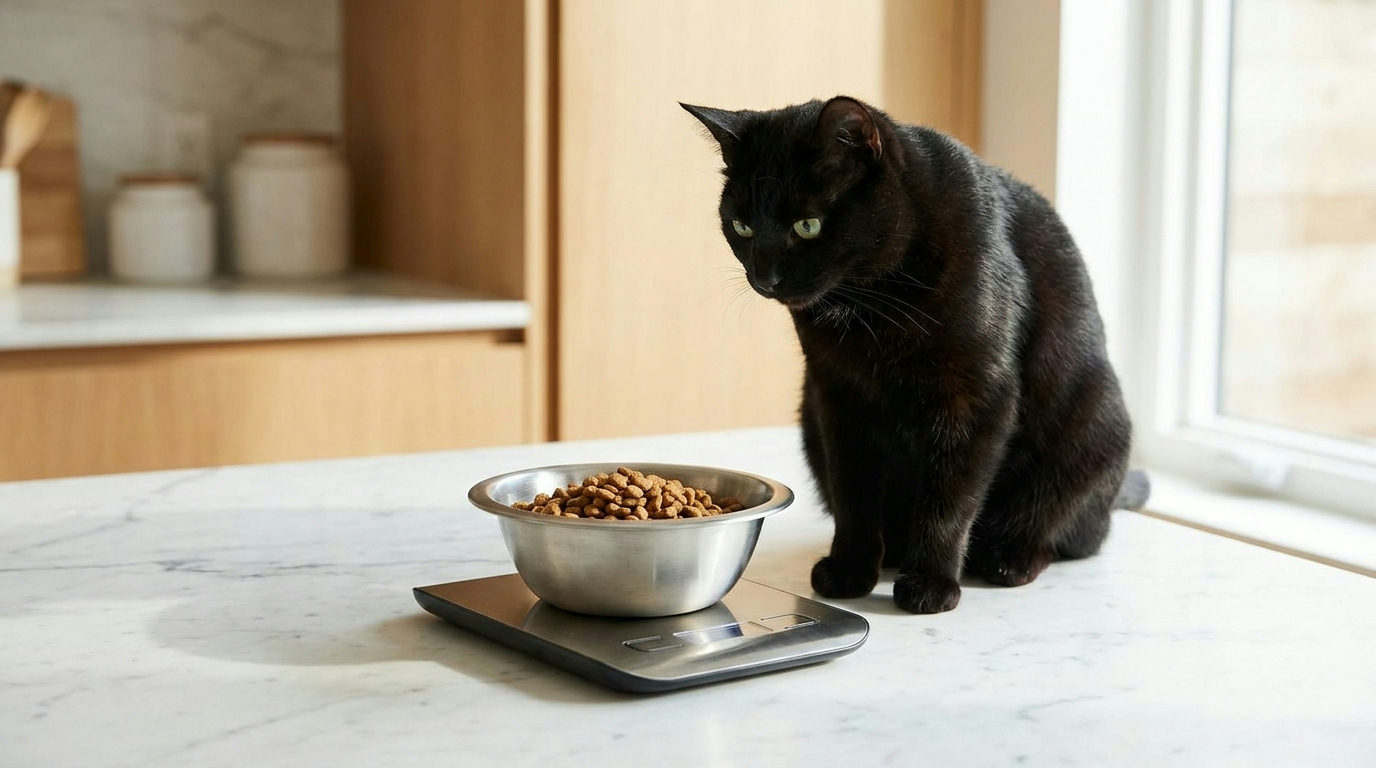
For daily feeding, however, the per-cup or per-can number is often more practical. Better still, weighing food on a kitchen scale in grams removes most of the guesswork. Our guide on how to measure cat food portions explains how to set this up.
Turning kcal/kg into kcal per gram
Here is a handy shortcut. Because a kilogram is 1,000 grams, you can divide the kcal/kg figure by 1,000 to get calories per gram. For example, a food listed at 3,500 kcal/kg contains 3.5 kcal in every gram. Once you know that, any portion becomes simple multiplication.
Comparing wet food with dry food
Wet food labels often list calories per can or pouch, which makes side-by-side comparison with kibble tricky. To compare them, check the net weight of the can in grams, then divide the calories per can by that weight. For instance, a can listed at 90 kcal that weighs 85 grams provides roughly 1.1 kcal per gram. Again, these numbers are only an illustration, so always use your own labels.
How Many Calories Does Your Cat Need?
Daily calorie needs depend on your cat’s weight, body condition, age, activity level, neuter status and health. Because of this, there is no single number that fits every cat.
The Pet Nutrition Alliance offers resources, including tools vets use to estimate a cat’s energy needs. Even so, any calculated figure is only a starting point. The best approach is to ask your vet for a daily calorie target, then adjust based on how your cat’s weight and body shape change over time.
Worked Example: Turning the Calorie Statement Into a Portion
Let us walk through an example. The numbers below are made up for illustration only, so use the figures on your own cat’s food and the target your vet gives you.
Suppose your vet suggests your adult cat needs about 220 kcal per day. You feed one can of wet food plus some dry food.
- Check the wet food label. Say it reads 80 kcal per can.
- Subtract the wet food. 220 − 80 = 140 kcal left for dry food.
- Check the dry food label. Say it reads 3,800 kcal/kg, which is 3.8 kcal per gram.
- Divide. 140 ÷ 3.8 ≈ 37 grams of dry food per day.
- Account for treats. If your cat gets treats, subtract those calories first. Many vets suggest keeping treats to a small share of daily calories.
- Split into meals. Divide the daily amount across your cat’s usual meals.
Now compare that with using cups. If the label says 400 kcal per cup, 140 kcal would be about a third of a cup. However, a loosely or heavily packed cup can change that a lot, which is why a scale is more reliable.
Quick Reference Table
| Label shows | What it means | Best used for |
|---|---|---|
| kcal/kg | Energy per kilogram of food | Comparing foods fairly; calculating grams |
| kcal/cup | Energy per standard measuring cup | Quick daily scooping (less precise) |
| kcal/can or pouch | Energy per container | Planning wet food portions |
| Feeding guide | Manufacturer’s suggested range | A rough starting point only |
Tracking and Adjusting Over Time
A calorie target is a best guess, so plan to fine-tune it. A simple routine looks like this:
- Weigh your cat at home or at the clinic every few weeks, at roughly the same time of day.
- Write down the weight alongside the daily portion you are feeding.
- Feel your cat’s ribs and look at the waist from above, or ask your vet to show you how to body condition score.
- If the trend is moving in the wrong direction, ask your vet how much to adjust rather than making a big change on your own.
Keeping these notes also makes it much easier to recalculate when you switch to a new food.
Common Mistakes to Avoid
- Assuming all foods have similar calories
- Switching foods but keeping the same scoop size
- Following the feeding guide exactly without checking your cat’s body condition
- Forgetting to count treats, toppers and food used for medication
- Free-feeding high-calorie dry food to an indoor cat without measuring
Frequently Asked Questions
Is the feeding guide on the bag wrong?
Not necessarily, but it is written for an average cat. Your cat may need more or less, so treat it as a starting range and adjust with your vet’s input.
Why does the label say “calculated”?
Calorie content is commonly estimated from the food’s composition rather than measured by feeding trials. It is a reliable guide for everyday portioning, even if it is not exact to the calorie.
Do I need to count calories forever?
Once you have a portion that keeps your cat at a healthy weight, you can simply weigh out that amount each day. Recalculate only when the food, your cat’s activity or your cat’s health changes.
When to Check In With Your Vet
Calorie math is a tool, not a diagnosis. Talk to your vet if your cat:
- Gains or loses weight despite steady portions
- Suddenly eats much more or much less than usual
- Has a health condition, is a kitten, is pregnant or is a senior
- Needs to lose weight, since cats should lose weight gradually under supervision
Unexplained weight change can be a sign of illness, so do not adjust portions alone in that situation.
The Bottom Line
The cat food calorie statement turns a vague feeding guide into a real plan. Use kcal/kg to compare foods, use your vet’s daily calorie target to work out portions, and weigh food when you can. Recheck the numbers every time you switch foods, and keep an eye on your cat’s weight so you can adjust with your vet’s help.
This article is for general information only and is not veterinary advice. It is not a substitute for advice from a licensed veterinarian who knows your cat.


