
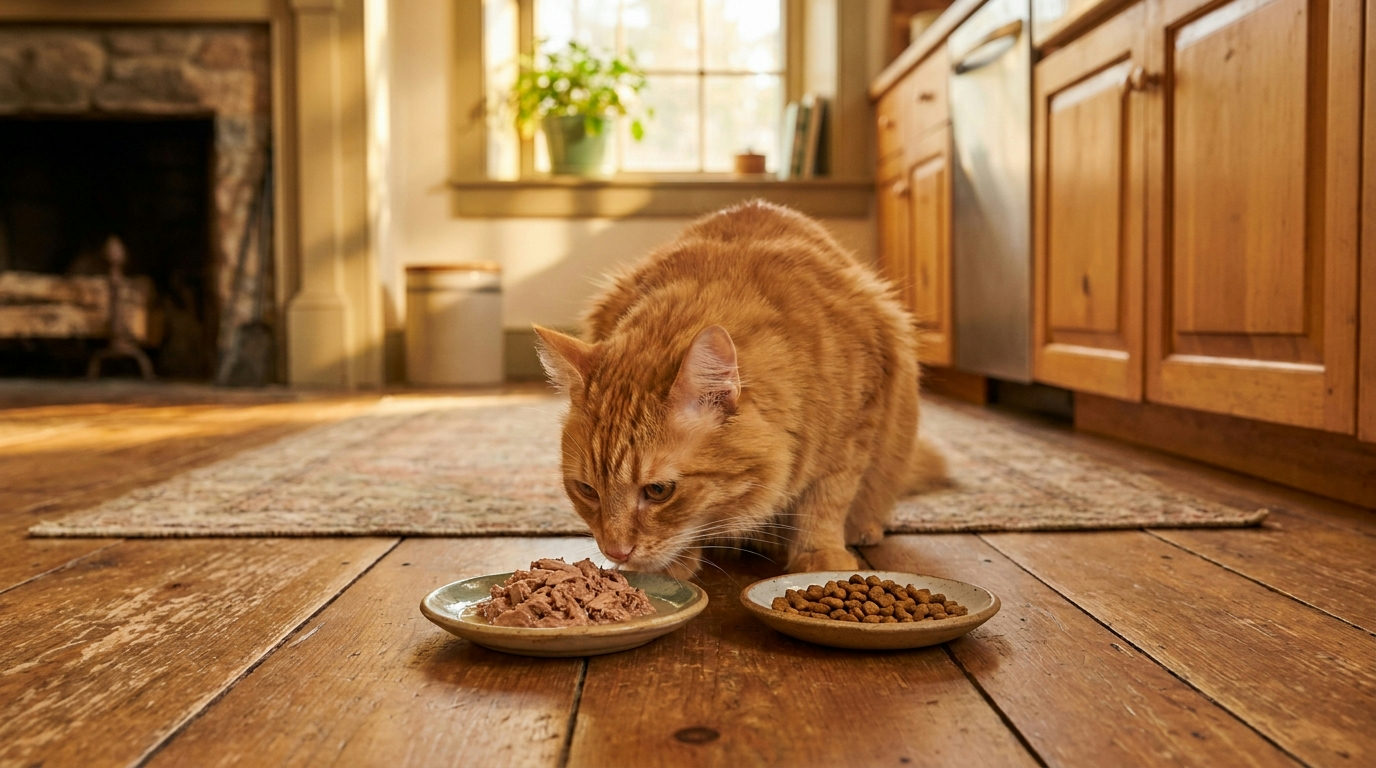
Many owners worry that feeding the same food every day must be boring or unhealthy for their cat. After all, people get tired of eating the same meal. However, the cat food variety myth assumes cats think about food the way we do, and that is not quite right. The real answer depends on what your cat eats, how your cat handles change and what you are hoping variety will achieve.
Disclosure: Cat Nutrition Guide may earn a commission from qualifying purchases made through links on this page, at no extra cost to you.
In this article, we separate myth from reality. We look at what “complete and balanced” means, why some cats resist new foods, the downsides of constant switching and the situations where a little variety may genuinely help.
The Cat Food Variety Myth: Where It Comes From
The idea that cats need variety usually comes from two places. First, there is our own experience: humans need a varied diet because no single meal provides everything we need. Second, there is marketing, with endless flavors and formats that suggest a cat should be offered something new every day.
The key difference is that a commercial cat food labeled complete and balanced is designed to provide all the nutrients a cat needs for its life stage on its own. In other words, variety is not required for nutritional completeness when the base food already meets that standard. Your vet can confirm whether your cat’s current food fits the bill.
What “Complete and Balanced” Means
The WSAVA Global Nutrition Guidelines encourage vets and owners to look closely at how a pet food is formulated and whether it is intended to be complete and balanced for the animal’s life stage. A food that meets this standard is meant to be fed as the sole diet.
By contrast, foods labeled as treats, toppers, or “for supplemental or intermittent feeding” are not designed to meet all of a cat’s needs. Rotating between these without a complete base can leave gaps, even if the menu looks varied.
So the first reality check is simple: a varied diet is not automatically a balanced one, and a consistent diet is not automatically a poor one.
Food Neophobia: Why Some Cats Resist New Foods
Some cats are wary of unfamiliar food, a behavior known as food neophobia. Others seem to enjoy novelty, at least for a while. Both patterns are normal, and they vary from cat to cat.
Feline welfare organizations such as International Cat Care note that early experiences may shape what a cat accepts later. A cat that only ever ate one texture as a kitten may be more hesitant to try others as an adult.
This matters for a practical reason. If your cat ever needs a prescription diet, it can help if the cat is already comfortable with more than one texture or format. That is one of the more convincing arguments for some carefully managed variety.
The Downsides of Constant Switching
Frequent, sudden food changes are not risk-free. Possible downsides include:
- Stomach upset: Abrupt changes may lead to vomiting, soft stool or diarrhea in some cats.
- Picky eating: Some cats learn that refusing a meal leads to something new and tastier.
- Harder detective work: If your cat develops a food sensitivity, a constantly changing menu makes it harder for your vet to find the trigger.
- Calorie creep: Different foods have very different calorie contents, so swapping without adjusting portions can lead to weight gain.
- Accidental imbalance: Rotating through toppers or treats in place of complete food can leave nutritional gaps.
When Variety May Help
On the other hand, there are situations where offering more than one food may be useful:
- Texture flexibility: Getting a cat used to both wet and dry formats can make future diet changes easier.
- Hydration: Adding wet food to a dry-food diet may help increase water intake, which some vets recommend for certain cats.
- Backup options: If one food becomes unavailable or is recalled, a cat that already accepts a second complete food is easier to manage.
- Enrichment: Puzzle feeders and different feeding spots can add interest without changing the food itself.
Notably, none of these require a new flavor every day. A small rotation of two or three complete foods that suit your cat is usually plenty for owners who want flexibility.
Myth vs Reality at a Glance
| Myth | Reality |
|---|---|
| Cats get bored eating the same food. | Cats vary. Many happily eat one complete food long term. |
| Variety is needed for good nutrition. | A complete and balanced food is designed to meet needs on its own. |
| More flavors means a healthier cat. | Frequent switching may cause stomach upset or picky eating. |
| Rotating treats counts as variety. | Treats and toppers are not complete meals. |
| Variety never matters. | Some texture flexibility may make future diet changes easier. |
How to Introduce a New Food Safely
If you decide to add a second food, go slowly. A gradual transition is widely recommended. A common approach looks like this:
- Days 1–2: About one quarter new food, three quarters current food.
- Days 3–4: Roughly half and half.
- Days 5–6: About three quarters new food.
- Day 7 onward: All new food, or your planned rotation mix.
Some cats need a slower pace, stretching this over two weeks or more. In addition, check the calorie content of each food and adjust portions so your cat’s total intake stays steady. Our guide on how to measure cat food portions walks through this.
Red flags to watch for
Call your vet if, during or after a food change, your cat:
- Refuses food for more than a day
- Vomits repeatedly or has ongoing diarrhea
- Seems lethargic, hides or loses weight
- Shows blood in vomit or stool
Cats that stop eating can become unwell, so do not wait it out.
Worked Example: A Sensible Rotation
Imagine a healthy adult indoor cat eating one complete dry food. The owner wants to add moisture and flexibility. A reasonable plan might be to introduce one complete wet food over a week or two, then settle into a routine of wet food in the morning and measured dry food in the evening.
The owner would adjust the dry portion to account for the calories in the wet food and weigh the cat every few weeks. That plan adds variety with a purpose rather than variety for its own sake. Of course, it is worth running the plan past the vet first.
Questions to Ask Your Vet
- Is my cat’s current food complete and balanced for its life stage?
- Would adding wet food make sense for my cat?
- How should I adjust portions if I feed two foods?
- Does my cat have any health issues that make diet changes risky?
- How slowly should I switch foods for my cat?
The Bottom Line
The cat food variety myth suggests cats need a changing menu to stay healthy. In reality, a complete and balanced food can meet a cat’s needs on its own, and frequent switching may cause more problems than it solves. That said, some purposeful variety, such as texture flexibility or added moisture, may help. Change foods gradually, keep portions in check and talk to your vet before making big changes.
This article is for general information only and is not veterinary advice. It is not a substitute for advice from a licensed veterinarian who knows your cat.


