
How to store cat food is a label question plus public FDA pages, not a guess about how long a bag should last. This guide walks through dry food, wet food, and foods the label calls raw or freeze dried. It does not set a dose, a calorie target, or a treatment. It is general information, not veterinary advice. If your cat is vomiting, refusing food, or you suspect spoilage made the cat ill, contact a veterinarian. If the bag prints a storage line, that line outranks this article.
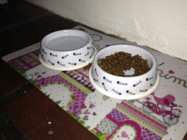
The photograph is Cat food (pellets and water).jpg by Deavmi, CC BY-SA 4.0, on Wikimedia Commons. It shows dry pellets and a water bowl. It is not a generated image and it is not a laptop keyboard. Cat Nutrition Guide may earn a commission from qualifying purchases made through links on this page, at no extra cost to you.
How to store cat food starts with the package you can still read
The FDA’s page on proper storage of pet food and treats gives the reason to keep the original bag or can. The lot number, the product name, the manufacturer, and the best-by date are how you identify the food if something goes wrong. A second page, Save Your Pet Food Lot Number, says the same thing in more detail: if you move food into another container, keep the original package inside it, or cut out the lot number and tape it where you will find it.
Copy the product name, the maker, the lot number, and the best-by date the day you open the food. You are not scoring nutrition. You are making the next recall check possible. The lot page explains why a complaint without that number is harder to match. This article does not restate their complaint tally.
- Original bag or can: keep it, even if you also use a bin.
- Lot number and best-by date: write them down or tape the cut-out panel to the bin.
- A cool, dry place: the FDA storage page says where dry pet food and unopened canned food should sit, and why heat and moisture matter. Read that sentence on their page. This article does not restate a temperature or a nutrient claim.
- A lid: the same page says a snug lid helps freshness and keeps a pet out of the supply.
- A secure spot: so one animal cannot eat the whole store at once, which the FDA lists as a reason storage matters.
Dry food: bag first, bin second
Leave dry food in its bag. Fold or clip the bag the way the FDA handling page describes: store dry food in its original bag and keep the top tightly folded down. Then set that bag inside a clean bin if you want a barrier against a determined cat. Do not pour the kibble into the bin and throw the bag away. If you already did that, tape the lot panel to the bin before the next scoop.
Wash and dry the bin before the next bag goes in. Use a clean scoop, not the food bowl. The FDA’s handling tips say not to use a pet dish as a scoop. A garage or a shed is a poor default if it gets hot or damp, because the storage page warns about heat and moisture. Read the line there. If you cannot measure the room, move the bag to the coolest dry cupboard you have and say so on your note, rather than inventing a shelf life.
This article does not assign a span of weeks to an open bag. The bag’s best-by date is the date the maker printed for the unopened product. After opening, follow any open-bag sentence the maker printed. If there is no such sentence, ask the maker. A blog does not get to invent one.
Wet food: unopened is not the same as opened
Unopened cans and pouches can sit with the dry food in that cool, dry place. The storage page groups unopened canned food with dry food for that step. Opening changes the rule. The FDA’s tips for safe handling of pet food and treats say what to do with leftover canned and pouched food, including the refrigerator setting. Follow that page. This article does not restate the setting.
Read the can for any shorter instruction and follow the shorter one. Do not microwave food in the can. If you warm a portion, move it to a dish first, and only if the label allows it. Some cats leave cold food. That is an observation you can test with a small portion, not a reason to leave a can on the counter. Use the timing word on the FDA page. This page will not replace it with an hour count.
Leftovers in the bowl
Follow the leftover line on the handling page. Wash the bowl before the next meal. Dry food left in a bowl can still pick up moisture, so refresh the bowl on a schedule you can keep, and wash it. Do not treat yesterday’s wet food as today’s meal because it still looks glossy.
Raw and freeze dried: two labels, two paths
If the label says raw, storage is the raw-diet page, not the dry-kibble habit. Open the FDA raw pet food page and follow its storage and thawing lines there. This article does not restate a hand-wash time or a thawing method. Keep raw food separate from other food, as that page says, and use its leftover line.
If the label says freeze dried, read whether it also says raw. Freeze drying is a format. Raw is a safety category. Do not assume one word includes the other. Unopened dry pieces follow the cool, dry, original-bag rule on the storage page. After you add water, treat the bowl as opened perishable food and follow the label if it is stricter. Do not use a different article as a storage time.
Recalls, pests, and what not to claim
Keep the lot number where you can read it during a recall. The FDA explains how that number ties a complaint to a plant and a date. Check the FDA recall list when you hear a name that matches your bag. Matching means the brand, the variety, and the lot, not a vague memory of the color of the bag.
Pests and a bad smell are reasons to stop using that bag and to ask the maker, or a veterinarian if a cat already ate it. They are not a reason to publish a nutrient-loss percentage. Read the storage page for what it says about heat and moisture. This article does not name a vitamin, a percentage, or a disease.
It also does not say a particular bin brand is required. Any clean container with a lid that closes is the idea the FDA describes. The useful test is whether you can still read the lot number and whether the cat can open the bin.
A kitchen card you can reuse
Write one card and tape it inside the cupboard. Dry food: original bag, inside a closed bin, in the place the FDA storage page describes. Wet food unopened: same place. Wet food opened: follow the handling page for leftovers. Raw: follow the raw-diet page. Freeze dried: follow the raw path only if the label says raw; otherwise follow the dry path until water is added.
Add the date you opened the current bag and the lot number. When the bag is finished, start a new line. Do not average two lots. Do not store dog food and cat food where one animal can open both, which is one of the mix-ups the FDA storage page names.
The practical close is the same sentence you can say out loud. How to store cat food means the original package stays readable, the FDA pages are the ones you open for any temperature or time, and any minute or week that is not printed on the bag stays off the card.


